Saturday, 27 December 2014

7 Personal Characteristics Of A Good Leader

How often have you heard the comment, "He or she is a born leader?" There are certain characteristics found in some people that seem to naturally put them in a position where they're looked up to as a leader.
Whether in fact a person is born a leader or develops skills and abilities to become a leader is open for debate. There are some clear characteristics that are found in good leaders. These qualities can be developed or may be naturally part of their personality. Let us explore them further.
SEVEN PERSONAL QUALITIES FOUND IN A GOOD LEADER
1. A good leader has an exemplary character. It is of utmost importance that a leader is trustworthy to lead others. A leader needs to be trusted and be known to live their life with honestly and integrity. A good leader "walks the talk" and in doing so earns the right to have responsibility for others. True authority is born from respect for the good character and trustworthiness of the person who leads.
2. A good leader is enthusiastic about their work or cause and also about their role as leader. People will respond more openly to a person of passion and dedication. Leaders need to be able to be a source of inspiration, and be a motivator towards the required action or cause. Although the responsibilities and roles of a leader may be different, the leader needs to be seen to be part of the team working towards the goal. This kind of leader will not be afraid to roll up their sleeves and get dirty.
3. A good leader is confident. In order to lead and set direction a leader needs to appear confident as a person and in the leadership role. Such a person inspires confidence in others and draws out the trust and best efforts of the team to complete the task well. A leader who conveys confidence towards the proposed objective inspires the best effort from team members.
4. A leader also needs to function in an orderly and purposeful manner in situations of uncertainty. People look to the leader during times of uncertainty and unfamiliarity and find reassurance and security when the leader portrays confidence and a positive demeanor.
5. Good leaders are tolerant of ambiguity and remain calm, composed and steadfast to the main purpose. Storms, emotions, and crises come and go and a good leader takes these as part of the journey and keeps a cool head.
6. A good leader, as well as keeping the main goal in focus, is able to think analytically. Not only does a good leader view a situation as a whole, but is able to break it down into sub parts for closer inspection. While keeping the goal in view, a good leader can break it down into manageable steps and make progress towards it.
7. A good leader is committed to excellence. Second best does not lead to success. The good leader not only maintains high standards, but also is proactive in raising the bar in order to achieve excellence in all areas.
These seven personal characteristics are foundational to good leadership. Some characteristics may be more naturally present in the personality of a leader. However, each of these characteristics can also be developed and strengthened. A good leader whether they naturally possess these qualities or not, will be diligent to consistently develop and strengthen them in their leadership role.
Barbara White President of Beyond Better Development has over twenty years experience in leadership. Beyond Better Development works with organizations who want their leaders to develop towards their potential and stay on the cutting edge. More about Leadership Development and Good Leadership Skills [http://www.beyondbetterleadership.com]
Article Source: http://EzineArticles.com/?expert=Barbara_White

Thursday, 11 December 2014


A gifted artist can instantly tell the difference between an average painting and a great painting. Someone gifted in playing the piano can instantly hear when a wrong note is played.
In sports, the best players just seem to know where the ball/puck is about to be next. As hockey legend Wayne Gretsky stated: “I go to where the puck will be.”
What is that often separates someone from being good at something versus being really great?
Intuition.
As a differentiating value, Intuition means instinctively knowing; ability to acquire knowledge without inference (the need for conscious reasoning).
What’s important to note about this value is that we ALL possess intuition. We just tend to be intuitive in our areas of strength.
Personally, I am not intuitive in the area of dancing. I’ve had little practice. And I couldn’t tell a good dancer from a bad one, no matter how much I might watch “Dancing with the Stars”.
But I can learn to dance. Recently I met someone (Dawn Stuart) who specializes in teaching married couples how to dance (called Marriage Dance). So, if acquiring the skills to dance is important to me, I have found a way.
The same is true for leaders.

The Leadership Test

Leadership guru, John Maxwell, suggests that leaders evaluate everything with a leadership bias. Being intuitive in the area of leadership is often what separates great leaders from good ones.
Are you intuitive in the area of leadership?
Here’s the test: do you see leadership issues before others, or do others see leadership issues before you do?
If you are naturally gifted in leadership, then you likely already possess leadership intuition.
But if you find others see issues before you do, don’t beat yourself up. And don’t give up. Just recognize that for you, leadership is an acquired skill versus a natural skill.

Developing Leadership Intuition

If you are not naturally gifted with leadership talents (and many of us, including me, are not!), there are 3 ways to develop the skills of leadership intuition.
1)    Surround yourself with naturally gifted leaders. Let them be your eyes and ears. Leverage their leadership intuition. And don’t be threatened by them. People don’t just follow ‘born’ leaders. People follow others for many different reasons, including: shared passion, shared values, and shared goals.
2)    Learn to read people. Pick up a couple of books on building relationships. Become a people watcher. And practice by engaging with more people, more often.
3)    Train yourself to ask specific leadership questions. Maxwell offers the following:
        a.     Who is the best person to take this on?
        b.    What resources do we possess that can help us?
        c.     What will this take financially?
        d.     How can I encourage my team to achieve success?
If you are in a leadership role, or aspire to be a leader, then develop the value of leadership intuition.
Be the leader, and lead yourself.

What other questions can a leader ask to develop leadership intuition?


- See more at: http://fergusonvalues.com/2012/03/how-to-develop-leadership-intuition/#sthash.U2HuENfi.dpuf

Top Five Signs for Recognizing Intuitive Leaders

Top Five Signs for Recognizing Intuitive Leaders

Author Douglas Adams writes that, "Human beings, who are almost unique in having the ability to learn from the experience of others, are also remarkable for their apparent disinclination to do so." Having a wealth of experience to draw from is a key factor in being an intuitive leader.
"Green" employees may come up with or luck into good decisions every now and then, but those individuals whose have experienced both successes and failures yet have made the most of both are an asset to your organization.
"Dig up all the information you can, then go with your instincts. We all have a certain intuition, and the older we get, the more we trust it… I use my intellect to inform my instinct. Then I use my instinct to test all this data," Colin Powell, former U.S. Army General and Secretary of State, explains in his book My American Journey.
Do you trust the gut-reaction of the genius in your organization, or the individual whose choices have typically been informed ones, in which research and careful consideration was made? Being wise, rather than purely intelligent, helps guide intuition.
Those who effectively display intuition routinely reach decisions quickly based on their assessment of a given situation. Once their instinct points in a particular direction, they confidently and immediately shift into second gear in order to move things forward.

Being in tune with those around you enables you to adequately understand personality types, read body language, anticipate how others react in certain situations, and determine how to best leverage strengths and weaknesses. An employee who is well connected with co-workers will likely be intuitive in making personnel decisions and managing projects with multiple team members.
They will also know their own limits and realize when it is best to rely on the talents, abilities and even intuition of others. Those who have a tendency to isolate themselves will be out of touch with not only their intuition and their co-workers, but with your organizational goals as well.
"The responsibility of a leader is to define reality," Max DePree asserts in Leadership is an Art. Being cognizant your organization’s ever-changing details will pay big dividends in fine-tuning intuition. Many employees narrow their focus on the minutia of their job descriptions, causing them to disregard the world around them.
The intuitive individual successfully fulfills his or her role, yet also has the ability to step back and survey the entire landscape of your organization. He or she knows what financial assets, technology, personnel, and other resources are available and not only recognizes but expects changing industry trends. This type of intuitive employee will have a knack for making the right choices in future company decisions.

Intuition And Leadership


Intuition and leadership, is intuition important in leadership? What is intuition? And how does it affects leadership?

What is intuition? Intuition and leadership, these are subtle keys to effective leadership. Intuition is far different from instinct. Instinct is pattern of behavior which is a characteristic of a response to specific stimuli. Intuition is the ability to look inside or to contemplate.
One of the key traits of becoming an effective leader is that they know how to trust their intuition or instincts. They know how to listen to their inner voice. As Biily Gates said, “Often you have to rely on intuition”.
There are a lot of books, magazines and articles that tackles about how to be a good leader, how to be an effective leader, etc. But there are also times that we need to listen to our inner voice in deciding certain situations.
Books are written by experts on such field, but they can never tell you what to do in every situation that arises. If situation like this, like that and like those, books can’t tell you to do this, to do that. Of course, you can’t ask the book on what to do.
Time would come that you have to decide on your self and with this, you may listen to your intuition. Intuition and leadership are compact. Intuition is the foundation of imaginative awareness. It is the anticipation, vision and the ability to be wise in choosing which path to go.
Intuition and leadership; what are the signs of identifying intuitive leaders?
Wisdom
Do you trust your instincts in decision making? Effective leaders utilize wisdom than being smart. They rely on those who exhibit wisdom in decision making.
Awareness
Effective leaders should be realistic. He should have knowledge and conscious on the changes going on. He should know when to step forward and when to step back. He or she knows the needs of his team members, the financial assets, technology, and other funds available.
Connected
Intuitive leaders know how to be in tune. They are connected with their team members, with these he will be able to understand each personality types, read body language, knows each of his team members, anticipate how each act on certain situations and determine each strengths and weaknesses.
An intuitive leader who is connected with his team members will help him know the limitations and capabilities of each of his team member.

Speaking of reality, there are no perfect leaders, but leaders who follow their intuition when it comes to making decisions will have a better ending.

Wednesday, 10 December 2014

LEADERSHIP MYTHS


LEADERSHIP MYTHS
LEADERSHIP MYTHS
               From days gone by, there has been this myth that people have come to embrace wholeheartedly about leaders and leadership. Dr. John Maxwell grouped them into five:
1.       Management Myth
There has been this widespread believe or misunderstanding that leading and managing are one. While a good leader can do a managerial work very well, managers are not necessarily good leaders.
Management has to do with maintaining a laid down principles and rules. A manager makes sure that he maintains the processes that built up the system he is in and makes sure it is sustained. Managers can maintain directions, but they can’t change it.
Leadership is all about influencing people to follow, charting a course for people to follow and bringing it to fruition.  To bring in people to follow, you need influence. To test whether a person can lead other than managing, give him the task of making a positive change.

Monday, 8 December 2014

INFLUENCE IN LEADERSHIP


INFLUENCE IN LEADERSHIP

The true measure of leadership is influence- Nothing more, Nothing less.

             The necessity of influence in a leader’s life and his leadership cannot be over emphasised as leadership itself is influence. Dr. Maxwell will always say that “if you don’t have influence, you will never be able to lead others”. Leading without influence is like gathering water in a basket but with it you are limitless in your achievement. The power of influence in leadership is typified by mother Teresa. She was described by Lucinda Vardey as
“the quintessential, energetic entrepreneur, who has perceived a need and done something about it, built an organisation against all odds, formulated its constitution, and sent out branches all over the world”. Today, worldwide her charity organisation has outlived her. Her impact wasn’t just within her immediate environment, it went beyond that. Even when other organisations in the Catholic Church were dwindling, hers was touching the life of people from

MISCONCEPTIONS ABOUT LEADERSHIP.


Image credit: 72soul / 123RF Stock PhotoMISCONCEPTIONS ABOUT LEADERSHIP.
Leadership and position are two different conceptions that people sometimes take to be same or misunderstand it. The misunderstanding has always been there, people think that when someone is assigned a position, automatically that

Sunday, 7 December 2014

Charismatic Leadership Quality Questioned

Is Charismatic Leadership Essential?

Charismatic leadership is leadership based on the leader's ability to communicate and behave in ways that reach followers on a basic, emotional way, to inspire and motivate. We often speak of some sports and political leaders as charismatic (or not) -- an example being John F. Kennedy.
It's difficult to identify the characteristics that make a leader "charismatic", but they certainly include the ability to communicate on a very powerful emotional level, and probably include some personality traits.
Developing "charisma" is difficult, if not impossible for many people, but luckily charismatic leadership is not essential to be an effective leader. Many other characteristics are involved in leading effectively, and there is significant evidence to indicate that it simply is not necessary to have this elusive charisma to lead others well.
Relying on charisma to lead also can be problematic. For example, there have been many charismatic leaders who lack other leadership characteristics and skills (e.g. integrity) and lead their followers into situations that turn out horribly -- think political leaders such as Stalin, Hitler, and even business leaders (Enron).
Finally, in organizations lead by charismatic leaders, there is a major problem regarding succession. What happens when a leader who relies on charisma leaves? Often the organization founders because the ability to lead rested with one person's charisma.

Saturday, 6 December 2014

How to Build Trust


The job of a leader is to go first, to extend trust first. Not a blind trust without expectations and accountability, but rather a "smart trust" with clear expectations and strong accountability built into the process. The best leaders always lead out with a decided propensity to trust, as opposed to a propensity not to trust. As Craig Weatherup, former CEO of PepsiCo said, "Trust cannot become a performance multiplier unless the leader is prepared to go first."

The best leaders recognize that trust impacts us 24/7, 365 days a year. It undergirds and affects the quality of every relationship, every communication, every work project, every business venture, every effort in which we are engaged. It changes the quality of every present moment and alters the trajectory and outcome of every future moment of our lives -- both personally and professionally. . I am convinced that in every situation, nothing is as fast as the speed of trust.
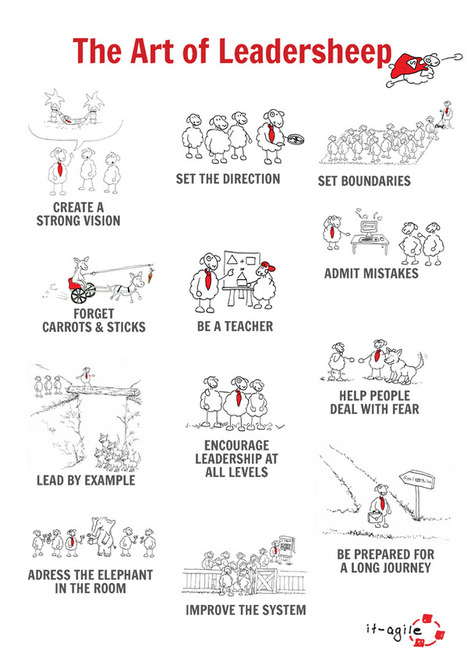
leadership art

The Art of Leadersheep | LeadershipABC | Scoop.it

What Makes an Influencial leader. 10 Qualities.

        Here then, are the "10 Critical Skills" identified for being an "Influential Leader"...
Storyteller
story telling
1. Storyteller - Everyone has a story to tell, stories have a way of gathering and concentrating attention towards you and there is a difference in attention paid to those that can truly tell a great story versus those that can't. Each of us has a story to tell whether we communicate verbally or never even open our mouths! What's the story you are telling right now? Is it accurate? Will it allow you to accomplish your hopes and dreams?
communicator 
2. Communicator - There is a difference between hearing and understanding. You communicate as a leader when people you are speaking to understands what you say. Social Psychologists have told us for years that speaking in public is the most common held fear of all. Fear of dying comes in third place! But being a good communicator is more than just your ability to speak in public, or private for that matter. Do you speak to speak, or do the people you communicate with really hear you and take action? There is a difference.
salesperson
3. Salesperson - We hate salespeople as a society, yet each of us is one! In every one of our actions we are either selling those we come in contact with on "Yes", or they are selling us on "No". There is a reason why this is the second oldest profession on the planet, and your ability to perform in it will determine whether you place a check mark in the "Influencer" or "Influenced" scorecard column!
4. Team Builder - The game of football is a typical example. every player goes into the field to play on the side of his strength. They say that no person in and of themselves is an island. Why then did a client recently declare team building to be dead in his organization? Team building efforts often fall short on what's in it for the individual. There is a disconnect between the strategic goals of the organization as well as the individual.
team builder
5. Coach - Mentoring, modeling and role playing are crucial for "game time" success. Who doesn't like having someone pick you up when you fall...You never fall?
6. Tecky - Technology comes at us fast and furious, and the one thing that can be guaranteed is that it will continue to come at us faster and more furious! The "Influential Leader" grabs hold of the technology that will propel them forward.
7. Strategic Planner - "A goal without a plan is just a dream" is a common refrain for goal setting. That's great! This is the planning phase, and the better you are at developing multiple/detailed plans, the better off you will be when it comes down to choosing your action path.
8. Customer Retainer - Customer Satisfaction is worthless. If your focus is on the one-time incident or encounter you will lose business. Why? True Influential Leaders realize that getting customers to come to them not only the first time, but time and time again is the only customer satisfaction variable that matters! That's called retention, and it is valuable! If your focus isn't on the "Big Picture", take a step back!
9. Change Agent - Change is inevitable...It marks progress sometimes, and regression others. Influential Leaders grasp the challenge of change by the horns! They know the risks as well as the potential rewards to be had.
trust
10. Trust - Trust is the one key leadership competency that changes everything. With it, you'll succeed. Without it...

Pictorial leadership quotes


leadership quotes funny leadership quotes military leadership quotes ...Leadership quotes (3)There were others that were, put simply , just very powerful :Leadership quotes

16 Most Powerful Leadership Quotes. Part B


Servant Leadership Quotes With Leadership QuotesBe a good listener
10. “The best leader is the one who has sense enough to pick good men to do what he wants done, and the self-restraint to keep from meddling with them while they do it.” -Theodore Roosevelt
Your people are your greatest resource; listen to their feedback and encourage their dreams. You never know where your next great idea will come from, so empower everyone up and down the corporate ladder to contribute and innovate. This gives you the opportunity to learn from your mistakes and being able to connect with your people.
11. “To lead people, walk behind them.” – Lao Tzu
Strike a Balance
12. “The challenge of leadership is

16 Most Powerful Leadership Quotes. Part A


          leadership quotes leadership quotes leadership quotes leadership ...One of the runaway routes employed by good leaders in wanting times has always been quotes by other great leaders. Whether you’re leading a huge team on a challenging project or just trying to climb the career ladder, these quotes can help provide some useful wisdom on how best to deploy your leadership strategy.
Here are some of the best quotes on how to be a better leader, sorted by the top leadership attributes they describe. This great advice from some of our most inspirational leaders just might make you rethink your current leadership strategy, renew your passion to lead, or point the way for how to better inspire your troops:
 Inspiration
1. “If your actions inspire others to dream

Thursday, 4 December 2014

Leadership Quotes 2


leadership quotes"Leadership is not so much about technique and methods as it is about opening the heart. Leadership is about inspiration—of oneself and of others. Great leadership is about human experiences, not processes. Leadership is not a formula or a program, it is a human activity that comes from the heart and considers the hearts of others. It is an attitude, not a routine."
— Lance Secretan, Industry Week, October 12, 1998


"More than anything else today, followers believe they are part of a system, a process that lacks heart. If there is one thing a leader can do to connect with followers at a human, or better still a spiritual level, it is to become engaged with them fully, to share experiences and emotions, and to set aside the processes of leadership we have learned by rote."
— Lance Secretan, Industry Week, October 12, 1998


"There is no power on earth that can neutralize the influence of a high, simple, and useful life."
— Booker T. Washington


"He is greatest whose strength carries up the most hearts by the attraction of his own."
— Henry Ward Beecher


"Max DePree popularized the idea that leadership is an art. So much of what a leader does cannot be objectively measured. To reduce leadership to a set of algorithms is to remove it from its context; to ignore the complexities, the contradictions, and the possibilities. Artists must deal with uncertainty, contradictions and diversity almost by definition. Leaders need to have this capacity."
— Michael McKinney


"Leadership is getting people to work for you when they are not obligated."
— Fred Smith


"Into the hands of every individual is given a marvelous power for good or evil - the silent, unconscious, unseen influence of his life. This is simply the constant radiation of what man really is, not what he pretends to be."
— William George Jordan


"Never doubt that a small group of thoughtful committed citizens can change the world. Indeed, it is the only thing that ever has."
— Margaret Mead


"My own definition of leadership is this: The capacity and the will to rally men and women to a common purpose and the character which inspires confidence."
— General Montgomery


"High sentiments always win in the end, The leaders who offer blood, toil, tears and sweat always get more out of their followers than those who offer safety and a good time. When it comes to the pinch, human beings are heroic."
— George Orwell


"It is no use walking anywhere to preach unless our walking is our preaching."
— St. Francis of Assisi


"Our chief want is someone who will inspire us to be what we know we could be."
— Ralph Waldo Emerson


"In the course of history, there comes a time when humanity is called to shift to a new level of consciousness, to reach a higher moral ground. A time when we have to shed our fear and give hope to each other. That time is now."
— Wangari Maathai


"I think leadership comes from integrity - that you do whatever you ask others to do. I think there are non-obvious ways to lead. Just by providing a good example as a parent, a friend, a neighbor makes it possible for other people to see better ways to do things. Leadership does not need to be a dramatic, fist in the air and trumpets blaring, activity."
— Scott Berkun


"Before you are a leader, success is all about growing yourself. When you become a leader, success is all about growing others."
— Jack Welch


"I think that the best training a top manager can be engaged in is management by example. I want to make sure there is no discrepancy between what we say and what we do. If you preach accountability and then promote somebody with bad results, it doesn't work. I personally believe the best training is management by example. Don't believe what I say. Believe what I do."
— Carlos Ghosn, CEO of Renault-Nissan


"Leadership is a posture and a choice, not a role that must be bestowed on you. Step up and be a leader when no one is watching or expecting you to do so."
— John Izzo and Marshall Goldsmith, Stepping Up


"When the conduct of men is designed to be influenced, persuasion, kind, unassuming persuasion, should ever be adopted. It is an old and a true maxim, that a "drop of honey catches more flies than a gallon of gall."
— Abraham Lincoln
February 22, 1842 in Temperance Address


"I strongly believe that the responsibility of leadership is to shape the debate—to practice and project the right attributes—whether in a business enterprise, in our society, and even in our religions."
— Farooq Kathwari, CEO Ethan Allen


"If you don't understand that you work for your mislabeled 'subordinates,' then you know nothing of leadership. You know only tyranny."
— Dee Hock


"The led must not be compelled; they must be able to choose their own leader."
— Albert Einstein


"Nearly all men can stand adversity, but if you want to test a man's character, give him power."
— Abraham Lincoln


"Lead and inspire people. Don't try to manage and manipulate people. Inventories can be managed but people must be lead."
— Ross Perot


"Those who try to lead the people can only do so by following the mob."
— Oscar Wilde


"The function of leadership is to produce more leaders, not more followers."
— Ralph Nader


"No institution can possibly survive if it needs geniuses or supermen to manage it. It must be organized in such a way as to be able to get along under a leadership composed of average human beings."
— Peter Drucker


"The best executive is the one who has sense enough to pick good people to do what he wants done, and self-restraint to keep from meddling with them while they do it."
— Theodore Roosevelt


"A leader is a dealer in hope."
— Napoleon Bonaparte


"To be able to lead others, a man must be willing to go forward alone."
— Harry Truman


"Example is not the main thing in influencing others; it is the only thing."
— Albert Schweitzer


"People ask the difference between a leader and a boss. The leader works in the open, and the boss in covert."
— Theodore Roosevelt


"If your actions inspire others to dream more, learn more, do more and become more, you are a leader."
— John Quincy Adams


"The leader has to be practical and a realist, yet must talk the language of the visionary and the idealist."
— Eric Hoffer


"Leadership is practiced not so much in words as in attitude and in actions.”
— Harold S. Geneen


"Leaders must be close enough to relate to others, but far enough ahead to motivate them."
— John Maxwell


"The key to successful leadership today is influence, not authority."
— Kenneth Blanchard


“Never tell people how to do things. Tell them what to do and they will surprise you with their ingenuity."
— General George Patton


"Leadership is a potent combination of strategy and character. But if you must be without one, be without the strategy."
— Norman Schwarzkopf


"The growth and development of people is the highest calling of leadership."
— Harvey S. Firestone


"One of the tests of leadership is the ability to recognize a problem before it becomes an emergency."
— Arnold Glasow


"Leaders conceive and articulate goals that lift people out of their petty preoccupations and unite them in pursuit of objectives worthy of their best efforts."
— John Gardner


"The ability to summon positive emotions during periods of intense stress lies at the heart of effective leadership."
— Jim Loehr


"People will emulate leaders’ behaviors, believing they have silent permission to parrot actions demonstrated at the top of the power hierarchy."
— Phil Buckley


"Leader in its most important sense means being the agent of your own life, influencing the things you care about most in the world to make it a richer life. "
— Stewart Friedman, Total Leadership


"But the effect of her being on those around her was incalculably diffusive: for the growing good of the world is partly dependent on unhistoric acts; and that things are not so ill with you and me as they might have been, is half owing to the number who lived faithfully a hidden life, and rest in unvisited tombs."
— George Eliot, Middlemarch

LEADERSHIP Quotes

Quotes


"To lead people, walk beside them ... As for the best leaders, the people do not notice their existence. The next best, the people honor and praise. The next, the people fear; and the next, the people hate ... When the best leader's work is done the people say, 'We did it ourselves!'"
— Lao-tsu


"If the blind lead the blind, both shall fall in the ditch."
— Jesus Christ


"Dictators ride to and fro upon tigers which they dare not dismount. And the tigers are getting hungry."
— Winston Churchill


"Control is not leadership; management is not leadership; leadership is leadership. If you seek to lead, invest at least 50% of your time in leading yourself—your own purpose, ethics, principles, motivation, conduct. Invest at least 20% leading those with authority over you and 15% leading your peers."
— Dee Hock
Founder and CEO Emeritus, Visa


"All of the great leaders have had one characteristic in common: it was the willingness to confront unequivocally the major anxiety of their people in their time. This, and not much else, is the essence of leadership."
— John Kenneth Galbraith


"If a rhinoceros were to enter this restaurant now, there is no denying he would have great power here. But I should be the first to rise and assure him that he had no authority whatever."
— G.K. Chesterton to Alexander Woollcott


"The task of the leader is to get his people from where they are to where they have not been."
— Henry Kissinger


"No institution can possibly survive if it needs geniuses or supermen to manage it. It must be organized in such a way as to be able to get along under a leadership composed of average human beings."
— Peter Drucker


"The task of leadership is not to put greatness into humanity, but to elicit it, for the greatness is already there."
— John Buchan


"Leadership is the art of getting someone else to do something you want done because he wants to do it."
— Dwight D. Eisenhower


"You do not lead by hitting people over the head — that's assault, not leadership."
— Dwight D. Eisenhower


"The best is he who calls men to the best. And those who heed the call are also blessed. But worthless who call not, heed not, but rest."
— Hesiod
8th Century BC Greek poet


"Never give an order that can't be obeyed."
— General Douglas MacArthur


"Leadership must be based on goodwill. Goodwill does not mean posturing and, least of all, pandering to the mob. It means obvious and wholehearted commitment to helping followers. We are tired of leaders we fear, tired of leaders we love, and of tired of leaders who let us take liberties with them. What we need for leaders are men of the heart who are so helpful that they, in effect, do away with the need of their jobs. But leaders like that are never out of a job, never out of followers. Strange as it sounds, great leaders gain authority by giving it away."
— Admiral James B. Stockdale


"Great leaders are almost always great simplifiers, who can cut through argument, debate, and doubt to offer a solution everybody can understand."
— General Colin Powell


"Without leadership, command is a hollow experience, a vacuum often filled with mistrust and arrogance.."
— Eric Shinseki


"I am reminded how hollow the label of leadership sometimes is and how heroic followership can be."
— Warren Bennis


"Men make history and not the other way around. In periods where there is no leadership, society stands still. Progress occurs when courageous, skillful leaders seize the opportunity to change things for the better."
— Harry Truman


"Leadership is intentional influence."
— Michael McKinney


"The leader is one who mobilizes others toward a goal shared by leaders and followers. ... Leaders, followers and goals make up the three equally necessary supports for leadership."
— Gary Wills
Certain Trumpets: The Call of Leaders


“"Education makes a people easy to lead, but difficult to drive; easy to govern, but impossible to enslave."
— Henry Peter Brougham, The Present State of Law, 1828


"A leader is one who influences a specific group of people to move in a God-given direction."
— J. Robert Clinton


"All Leadership is influence."
— John C. Maxwell
Injoy, Inc.


"Now there are five matters to which a general must pay strict heed. The first of these is administration; the second, preparedness; the third, determination; the fourth, prudence; and the fifth, economy."
— Wu Ch'i (430-381 BC)


"You cannot be a leader, and ask other people to follow you, unless you know how to follow, too."
— Sam Rayburn


"Your position never gives you the right to command. It only imposes on you the duty of so living your life that others may receive your orders without being humiliated."
— Dag Hammarskjöld


"The final test of a leader is that he leaves behind him in other men, the conviction and the will to carry on."
— Walter Lippmann


"The function of a leader within any institution: to provide that regulation through his or her non-anxious, self-defined presence."
— Edwin H. Friedman, A Failure of Nerve


"People ask the difference between a leader and a boss. The leader leads, and the boss drives."
— Theodore Roosevelt


"A community is like a ship; everyone ought to be prepared to take the helm."
— Henrik Johan Ibsen, An Enemy of the People, Billing, Act I


"Humans will probably always need the help of especially gifted moral leaders in order to extend the bonds of caring and trust beyond the easy range of the family and the face-to-face community. Such bonds have become essential to the future of humanity."
—Paul R. Lawrence, Driven To Lead


"Leadership cannot really be taught. It can only be learned."
— Harold Geneen


"The first responsibility of a leader is to define reality. The last is to say thank you. In between, the leader is a servant."
— Max DePree


"Four rules of leadership in a free legislative body:
First, no matter how hard-fought the issue, never get personal. Don't say or do anything that may come back to haunt you on another issue, another day....
Second, do your homework. You can't lead without knowing what you're talking about....
Third, the American legislative process is one of give and take. Use your power as a leader to persuade, not intimidate....
Fourth, be considerate of the needs of your colleagues, even if they're at the bottom of the totem pole...."
— George Bush
Former President of the United States


"Speak Softly and carry a big stick; you will go far."
— Theodore Roosevelt


"Management is efficiency in climbing the ladder of success; leadership determines whether the ladder is leaning against the right wall."
— Stephen R. Covey


"Authority should be seen as a part of leadership, not as a way around it."
— Michael McKinney


"He who has great power should use it lightly."
— Seneca


"How do you know you have won? When the energy is coming the other way and when your people are visibly growing individually and as a group."
— Sir John Harvey-Jones


"He makes a great mistake ... who supposes that authority is firmer or better established when it is founded by force than that which is welded by affection."
— Terence


"The leader must know, must know that he knows, and must be able to make it abundantly clear to those around him that he knows."
— Clarence Randall


"You don't lead by pointing and telling people some place to go. You lead by going to that place and making a case."
— Ken Kesey


"As a leader, you're probably not doing a good job unless your employees can do a good impression of you when you're not around."
— Patrick Lencioni


"Leadership is difficult but it is not complex."
— Michael McKinney


"Look over your shoulder now and then to be sure someone's following you."
— Henry Gilmer


"Leadership is not magnetic personality, that can just as well be a glib tongue. It is not "making friends and influencing people", that is flattery. Leadership is lifting a person's vision to higher sights, the raising of a person's performance to a higher standard, the building of a personality beyond its normal limitations."
— Peter F. Drucker


"Leadership is the ability to establish standards and manage a creative climate where people are self-motivated toward the mastery of long term constructive goals, in a participatory environment of mutual respect, compatible with personal values."
— Mike Vance


"The older I get the less I listen to what people say and the more I look at what they do."
— Andrew Carnegie


Tuesday, 2 December 2014

Knowing Oneself and the Organization

The “leadership on parade” process must begin with honest assessments by the leader of how the workforce perceives him and how he in turn views the employees. Mistaken impressions can hinder communication and, with that, the leader’s effectiveness.

A leader may misunderstand the workforce's values, particularly if he is new. He may have come from a company whose employees value making lots of money but his new culture emphasizes a concept like "do no evil." Judgments from trusted direct reports will be needed because even a small change that runs counter to the culture can have large repercussions.

The workforce may not have a good understanding of the leader either. The leader may have served for many years but has not been very visible. Unknowingly, the leader may be sending out contrary signals. Is the leader shirt-sleeved or double-breasted? Occupying a walnut-paneled corner office or at the center of the floor? Each is making a values statement. With these and other choices, leaders must project their true selves.

This is not a call for the leader to improve his "image.” Image is artifice. For honest, leadership noweffective communication there must be authenticity.

Get Out from Behind the Lectern


Leaders who are effective presenters do not use a lectern, a barrier that separates the leader from the audience. They have no need for lecterns because they do not read from a written text. They understand that presentations that are read are considered old news and, as such, detract from the spontaneity that creates energy in the audience. Doing without visuals can be a particularly effective when the presentation is intended to inspire the audience rather than convey information.

Effective leaders showcase their passion by putting their whole body into the presentation. They support every statement with an appropriate gesture and make large body movements to underscore important points. They further accentuate these points with dramatic pauses or by raising or lowering their voice. Their choice of language demonstrates they are real because they avoid euphemisms, jargon and office-speak.

Though the presentation may appear spontaneous, it has been carefully rehearsed. Extraneous content has been put aside. Questions that may be asked have been identified and succinct, persuasive answers have been prepared. As noted earlier, though an initial presentation like this may require serious rehearsing, the process becomes easier as the leader seeks out opportunities to continue presenting. A seasoned speaker who gets a deep sense of pleasure from presenting can become encouraged to present his views about significant issues on the national stage. This further helps cement leadership positioning.